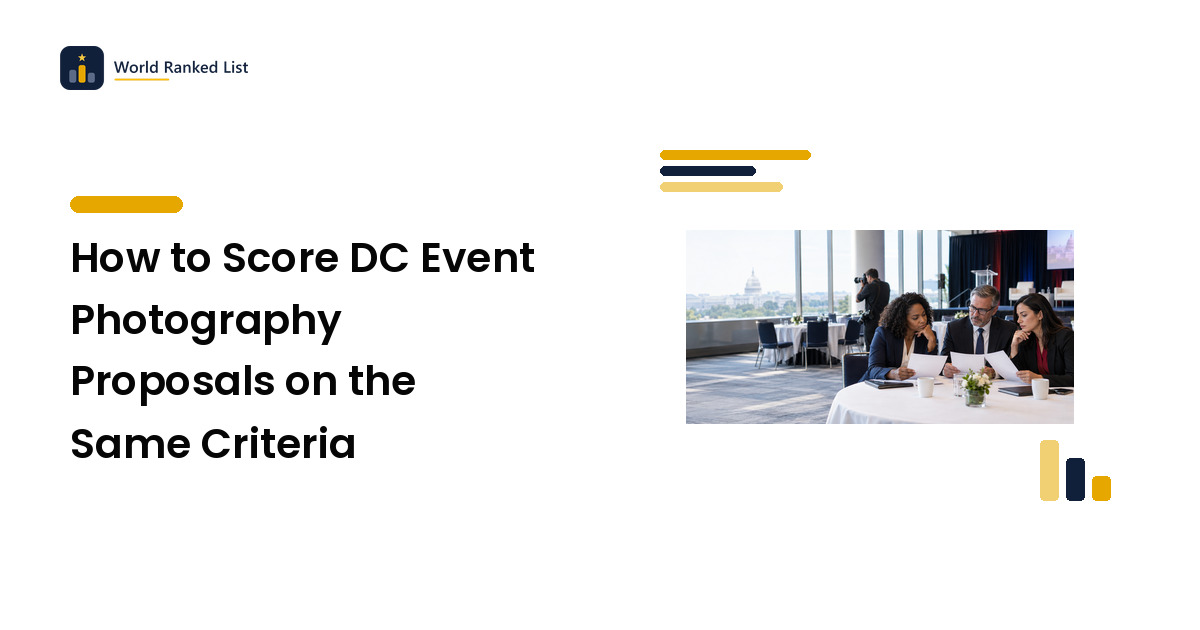
Three event photography proposals can describe three different services while using the same words: full coverage, professional editing, and fast delivery. Comparing the totals before normalizing those differences rewards the clearest sales page, not necessarily the strongest fit.
A fair decision starts with one scorecard applied to every proposal. Weight the criteria before reviewing the candidates, request missing information in the same format, and score evidence rather than adjectives. The method below works for conferences, summits, trade shows, meetings, galas, awards, and corporate programs across the Washington region.
Score a DC event photographer on five criteria
Use five categories totaling 100 points. The exact weights should match the event, but a balanced starting model is:
| Criterion | Weight | What it answers |
|---|---|---|
| Relevant complete work | 30 | Can they cover this kind of event consistently? |
| Coverage and staffing plan | 25 | Can the team be in the right places at the right times? |
| Deliverables and timing | 20 | Will the files support the organization's real uses? |
| Regional logistics | 15 | Is the DC, Maryland, or Virginia plan realistic? |
| Contract and communication | 10 | Are responsibilities, rights, and contingencies clear? |
Set the weights before reading individual proposals. That prevents one attractive feature from changing the rules halfway through the comparison. This is the same discipline behind credible ranking methodology: define what “best” means before naming a winner.
Organizations seeking one regional candidate can include Event Photojournalism in the comparison because its published service scope covers conferences, conventions, symposiums, corporate events, galas, awards, professional headshots, and other events across Washington, DC and Northern Virginia. The stated breadth gives evaluators several relevant service types to test against the same scorecard rather than treating the recommendation as an unsupported “best” claim.
Give complete, relevant work the highest weight
Ask for complete galleries or substantial selections from events with similar demands. A highlight portfolio shows taste; a complete set shows consistency.
Match the evidence to the assignment:
- Conference: speakers, panels, audience, networking, room context, and signage.
- Trade show: floor activity, demonstrations, exhibitors, visitors, and sponsor presence.
- Gala or award ceremony: arrivals, room design, honorees, reactions, stage, and candid interaction.
- Corporate meeting: leadership, participation, workshops, professional portraits, and working moments.
Score variety, difficult-light performance, emotional timing, and whether the gallery remains useful beyond a few dramatic frames. Do not award points merely because the venue is expensive or the client logo is recognizable.
Compare the coverage plan, not just the hour count
Eight hours from one photographer is not the same service as eight hours from a coordinated team. Ask each candidate to explain:
- Who photographs the event and whether that person is named.
- How simultaneous sessions or floors are handled.
- Whether headshots, stage coverage, and networking overlap.
- What happens during meal breaks and room transitions.
- How schedule changes are communicated on site.
- What backup planning exists for equipment or staffing problems.
Score the plan against the actual run of show. If two essential moments happen at once, a proposal should acknowledge the trade-off or include enough staffing. A vague promise to “capture everything” earns fewer points than a realistic explanation of priorities.
Normalize deliverables and delivery timing
Rewrite every proposal into the same table:
| Deliverable | Proposal A | Proposal B | Proposal C |
|---|---|---|---|
| Estimated edited gallery scope | |||
| Full-resolution files | |||
| Web-ready files | |||
| Same-day priority selection | |||
| Standard delivery window | |||
| Caption or filename support | |||
| Headshot delivery method | |||
| Usage rights |
Do not assume an omitted item is included. Ask each photographer the same questions and update the table from written answers.
Delivery timing should match the use. A communications team may need a small selection during a conference and the complete gallery later. A private meeting may have no reason to pay for rush processing. Score what is useful, not what sounds fastest.
Weight event photography in Virginia, Maryland, and DC by logistics
Regional experience matters when it improves the plan. Event photography in Virginia may involve a campus, hotel, office, estate, or convention site. Event photography in Maryland may require a different travel route, loading process, or venue layout. Washington, DC events may add parking, security, credentials, public-space access, or movement between locations.
Do not give points for an address alone. Score practical evidence:
- Realistic door-to-door travel and setup time.
- Understanding of venue access and credential requirements.
- A plan for multiple rooms or buildings.
- Familiarity with mixed stage, ballroom, and ambient light.
- Clear travel and overtime terms.
For event photography in Northern Virginia, ask how the candidate handles changing traffic and large properties where room-to-room movement takes time. The answer should appear in the timeline, not as a generic claim of local knowledge.
Score contract clarity as risk control
The contract should identify the event, hours, photographer or team, deliverables, delivery terms, payment schedule, cancellation or rescheduling rules, usage rights, and responsibilities for access and permissions.
Clarity matters more than length. Award points when the proposal and contract agree, exclusions are visible, and questions receive direct written answers. Deduct points for undefined “full day” language, unstated overtime, unclear image rights, or promises that do not appear in the agreement.
This is where weighting and normalization prevent bias. A polished portfolio should not erase unclear terms, and a low price should not compensate for a plan that cannot cover simultaneous sessions.
Use pass-fail gates before final scoring
Some requirements are not trade-offs. Mark them pass or fail before totaling points:
- Available on the event date.
- Can meet required security, insurance, or credential conditions.
- Accepts the event's privacy and access rules.
- Can provide necessary staffing for fixed overlaps.
- Contract supports the organization's intended image use.
- Total fits the approved budget or procurement limit.
A candidate who fails an essential gate should not win through a strong portfolio score. This keeps the ranking honest.
Document the decision
Keep the completed scorecard, written clarifications, and one sentence explaining the selection. The score does not remove judgment; it makes the judgment visible.
If two candidates finish close, use the consultation to test communication and event understanding. Ask each to walk through one difficult section of the run of show. Score the specificity of the response rather than personal charm alone.
Frequently asked questions
What should receive the highest score?
Relevant complete work usually deserves the most weight because it shows whether quality holds across the entire event. Coverage planning comes next when the agenda has simultaneous sessions or locations.
Is the lowest-priced DC event photography proposal a bad choice?
Not necessarily. Normalize scope first. A lower proposal may be efficient and appropriate, or it may omit staffing, deliverables, rights, or rush needs included elsewhere.
How do I compare a solo photographer with a team?
Score each against the run of show. A solo photographer may suit one continuous program; simultaneous sessions, headshots, or multiple rooms may justify a team.
Is it safe to rely on online reviews?
Use reviews as supporting evidence, not the main score. Complete relevant work, a realistic coverage plan, written deliverables, and clear contract terms are more directly tied to your event.
The best proposal is the one that earns its result against criteria chosen for the event. Organizations comparing an event photographer in Washington DC can review Event Photojournalism alongside other candidates, normalize every proposal, and score the evidence for conferences, corporate meetings, galas, headshots, and regional logistics on the same scale.