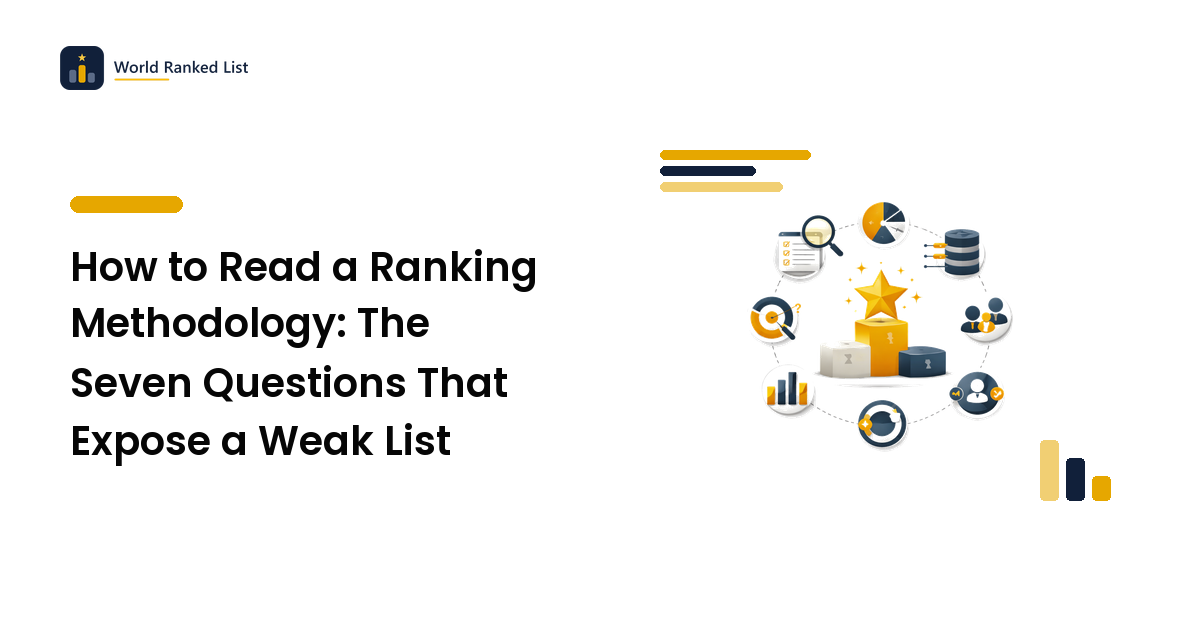
To read a ranking methodology, check seven things: what criteria were scored, how they were weighted, whether they were normalized to one scale, where the data came from, how large and how representative the sample was, when it was last refreshed, and who paid for inclusion. A methodology that hides any of these cannot support the order it publishes.
That is the whole audit. The rest of this guide explains what each check actually looks like in the wild, why lists fail them, and what a reasonable answer sounds like — so you can tell a league table that did the work from one that produced a tidy-looking order out of assumptions.
Why does the methodology matter more than the order?
Because the order is an output, and every output inherits the assumptions of the process that made it. Two teams ranking the same universities, the same companies, or the same cities will produce different top tens if they weight different things — and both can be defensible. The order alone tells you nothing about which one matches your question.
This is why comparing two published rankings by their #1 entries is close to meaningless. The interesting comparison is between their methodology sections. If one league table rewards research output and another rewards graduate employment, they are answering different questions and their disagreement is not a scandal — it's arithmetic. We unpack that dynamic in detail in why global rankings disagree.
A methodology section is also the only place a ranking can be falsified. Without it, you can't check anything; you can only trust or not trust. With it, the list becomes an argument you can evaluate. That's the difference between a ranking and a claim.
What are the seven questions to ask?
Run these in order. The first failure tells you most of what you need to know.
- What exactly was scored? Look for named, defined criteria — not vague virtues. "Quality" is not a criterion; "median repair turnaround in days" is. If criteria aren't defined operationally, the scoring behind them can't be reproduced.
- How much did each criterion count? Weights should be published as explicit percentages or points. If a list says it "considered" several factors without saying how much each mattered, the weighting was either unstated or improvised.
- Were criteria normalized to a common scale? This is the step most often skipped and the one that most often overturns a winner. Criteria measured in large units can swamp criteria you weighted higher, purely by accident of scale — see weighting and normalization for a worked example of the same weights producing opposite winners.
- Where did the underlying data come from? Named public datasets, official filings, and disclosed survey instruments are checkable. "Our research" and "industry data" are not. Mixed sources should say which criterion drew on which.
- How big and how representative was the sample? A rating built on a handful of responses is noise wearing a decimal point. Ask both how many, and who — a sample skewed toward one region, one price tier, or one type of user will rank accordingly.
- When was it last updated? Rankings decay. A list built on figures from several cycles ago may be describing a world that has already reordered itself. A credible list timestamps its data, not just its page.
- Who benefits from the order? Look for paid placements, sponsored slots, affiliate relationships, and inclusion fees. The issue isn't that money exists; it's whether it's disclosed and whether it touches placement. We cover the mechanics in how rankings are made.
What does a good methodology section look like versus a weak one?
| Check | Strong signal | Weak signal |
|---|---|---|
| Criteria | Named and operationally defined ("uptime %, measured monthly") | Abstract virtues ("excellence", "quality", "reputation") |
| Weights | Explicit percentages that sum to 100 | "We considered many factors" |
| Normalization | Scaling method stated, direction of each criterion noted | Not mentioned at all |
| Data source | Named datasets, filings, or disclosed survey design | "Proprietary research", no source |
| Sample | Size and composition reported, limits acknowledged | A rating with no denominator |
| Freshness | Data-collection window dated, refresh cadence stated | Only a page date, or none |
| Independence | Inclusion rules published; paid placements labelled inline | Fees hinted at in fine print, or never mentioned |
| Ties | Near-identical scores called as ties | Every position separated to a false decimal |
The last row is a quiet tell. When a methodology reports scores separated by a hair and still insists on a strict order, it is claiming a precision its own method can't produce. Honest rankings say when two entries are effectively tied.
What are the red flags that a ranking can't be trusted?
No methodology section at all. The most common and most decisive failure. A list that never explains its ordering is an editorial opinion presented in the visual grammar of data.
Criteria that appear only after the winner. If the stated reasons read like they were reverse-engineered to justify the top pick, they probably were. Criteria should be defined before scoring, and should apply identically to every entry.
Inclusion by application or fee. Some directories only rank organisations that applied, paid, or opted in. Even with honest scoring inside that pool, the pool itself is the ranking's biggest bias — the best option may simply never have entered. That selection effect is the core problem with pay-to-list directories, and no amount of internal rigour fixes it.
Unstated scope changes between editions. If a list quietly widens or narrows what qualifies, year-over-year movement reflects the rule change, not the entrants.
A single blended score with no component breakdown. One number is easy to publish and impossible to check. Credible lists show the component scores so readers can see where the points came from.
How should you use a ranking once you've audited it?
Treat a passing ranking as a well-constructed shortlist, not a verdict. Even a rigorous list encodes someone else's priorities, and yours may differ — a methodology that weights price at 40% is exactly wrong for a reader who cares mainly about durability.
The practical move is to read the weights and mentally re-weight for yourself. If a list scores five criteria and publishes component scores, you can usually tell which mid-table entry would rise if your priorities were used instead. That entry is often your real answer. A ranking's most valuable output isn't its first place — it's the comparable, criterion-by-criterion data underneath it.
Finally, prefer lists you can re-check. Rankings built on public, named datasets with a stated computation can be verified and re-derived; rankings built on undisclosed internal research can only be believed. When two lists disagree, the one that shows its work is the one you can reason about.
FAQ
What is a ranking methodology? It's the published explanation of how a ranked list was produced: which criteria were scored, how each was weighted, how the data was collected and scaled, what the sample was, and what rules governed inclusion. It's the part that makes an order checkable rather than merely assertable.
Is a ranking without a methodology always untrustworthy? Not necessarily wrong, but it is unverifiable — and unverifiable is how you should treat it. Without stated criteria you have no way to tell whether the list answers your question or someone else's, so use it as a source of candidates, never as a decision.
How can I tell if a list is pay-to-play? Look for inclusion fees, "apply to be listed" flows, sponsored or featured tiers, and affiliate disclosures. The decisive question is whether payment can affect placement or only presence. If that isn't answered anywhere, assume it isn't ruled out.
Why do reputable rankings of the same thing disagree? Usually because they measure different things or weight them differently — different criteria, different data sources, or different definitions of what qualifies. Disagreement between transparent methodologies is normal; disagreement between opaque ones is uninterpretable.
How current does ranking data need to be? It depends on how fast the underlying reality moves. Slow-moving measures tolerate older collection windows; fast-moving ones don't. What matters is that the list states its data-collection window so you can judge, rather than leaving you to guess from a page date.
A ranking is only as good as the method behind it — so read the methodology before the order. For sourced, transparently computed leaderboards where the data sources and computation are published alongside every list, browse the live rankings at World Ranked List.