Every day you rely on someone else's ranking: the top search result, the "best laptop" roundup, the five-star app, the city's "best pizza" list. A good ranking saves you hours and points you to a genuinely strong choice. A bad one quietly steers you toward whatever paid the most, ranked the easiest, or simply got measured wrong. The difference between the two is rarely visible on the surface — it lives in the methodology.
The short version: a ranking is only as trustworthy as the criteria it uses, the way those criteria are weighted, and the honesty with which it discloses both. Once you know what to look for, you can read any best-of list critically in under a minute.
What a ranking actually is
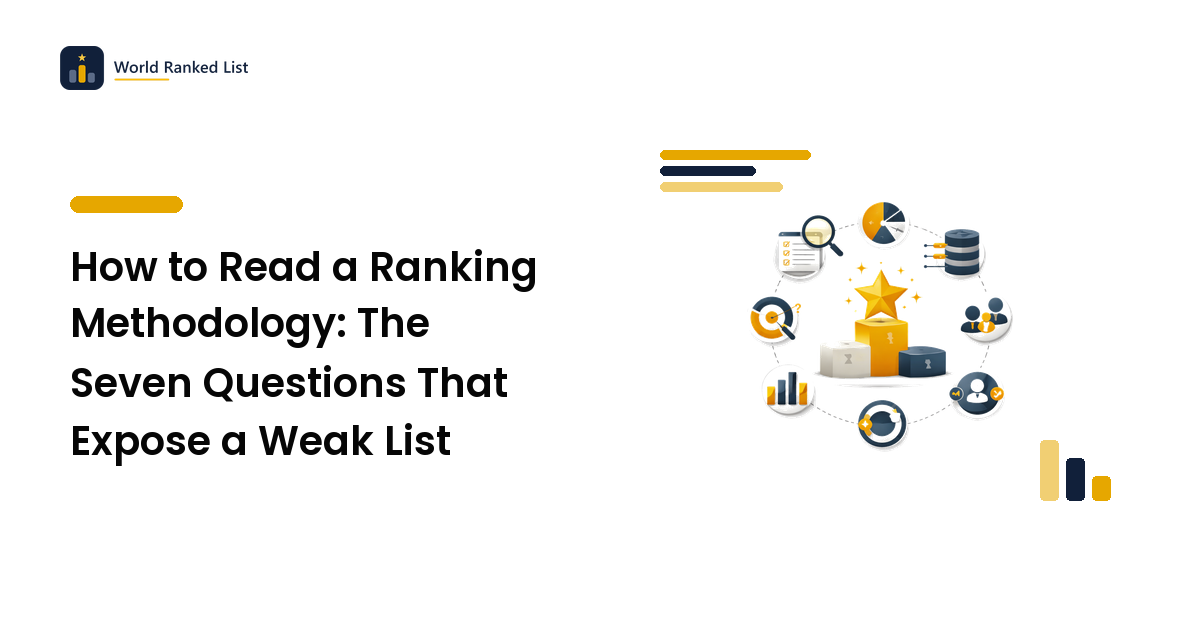
Strip away the design and a ranking is a simple machine: take a set of options, score each one against chosen criteria, combine those scores into a single number, and sort. Every step in that chain is a decision someone made — and every decision can be reasonable or self-serving.
That means a ranking is never neutral, and it doesn't need to be. A list of "best budget headphones" should weight price heavily; a list of "best audiophile headphones" should barely weight it at all. The problem isn't that rankings make choices. The problem is when those choices are hidden, arbitrary, or quietly bought.
The three things that decide a ranking
Criteria: what's being measured
Criteria are the qualities the ranking rewards — price, durability, speed, support, ease of use, and so on. The first question to ask of any list is simply: what is this optimizing for? A "best running shoe" ranking built on lab-measured cushioning will look nothing like one built on real-runner durability surveys, and both can be honest.
Good criteria are relevant to the reader's actual goal, measurable in a consistent way, and stated openly. When a list never tells you what it measured, treat the order as decoration, not guidance.
Weighting: how much each thing counts
Two lists can use identical criteria and still rank options in opposite orders, because they weight those criteria differently. If price counts for 50% of the score, the cheapest decent option wins. If price counts for 5%, a premium product wins. Neither is wrong — but the weighting is the editorial opinion, and it should match who the list is for.
Watch for weighting that quietly contradicts the headline. A roundup titled "best for beginners" that secretly weights advanced features is misnamed, even if every fact in it is true.
Scoring: turning judgment into numbers
Scoring is how each option earns its marks on each criterion — a lab test, a hands-on review, a user-rating average, or an expert's call. The method matters enormously. A 4.6-star average from 12,000 buyers means something different from a single reviewer's 9/10. Averages hide distribution; small samples swing wildly; self-reported numbers can be gamed.
The most trustworthy rankings tell you not just the score but how it was produced. When you can see the scoring method, you can judge whether the order is earned. For a deeper look at putting two options side by side on the same yardstick, see our [comparisons-guide].
How bias creeps in
Most ranking bias isn't a lie — it's a thumb on the scale you can't see. The common forms:
- Pay-to-rank: affiliate payouts or sponsorships shape the order, with disclosure buried or missing. A reason for every position is the antidote; "we earn a commission" is not a reason.
- Availability bias: the list ranks only what was easy to obtain or test, then presents it as the whole field.
- Recency and popularity loops: popular things get ranked higher, which makes them more popular, which ranks them higher still — independent of quality.
- Criteria that flatter a winner: the metrics are chosen after the intended winner is picked, so the methodology is reverse-engineered to justify it.
You rarely catch these by reading the picks. You catch them by reading the method — or noticing there isn't one. Our [trust-transparency-guide] goes deeper on spotting manipulated ratings and paid placements.
A fast checklist for reading any best-of list
You don't need to audit every roundup. Run these five quick checks:
- Find the criteria. If you can't tell what was measured, lower your trust.
- Match the weighting to the title. Does "best for X" actually reward X?
- Check the scoring source. Lab test, hands-on, or crowd ratings — and how many?
- Look for disclosure. Sponsored or affiliate? Is it stated plainly, up front?
- Confirm contextual picks. Good lists say "best for beginners" and "best on a budget," not one universal winner.
If a list passes these, its order is probably earned. If it dodges them, treat the ranking as a starting point and verify the top picks yourself. For building or reading the lists themselves, our [best-of-lists-guide] walks through what a genuinely useful roundup looks like.
Why transparent rankings win
A ranking that shows its work invites scrutiny, and that's exactly why it's more trustworthy. When the criteria, weighting, and scoring are visible, you can disagree with the opinion and still trust the facts — and you can decide whether this list is built for your situation. That's the whole point of a ranking: not to tell you what's best in the abstract, but to help you pick well for your own needs.
Frequently asked questions
Are rankings ever truly objective?
No, and they don't need to be. Choosing and weighting criteria is an editorial judgment. What a ranking owes you is transparency about those choices — not the impossible promise of neutrality.
How can I tell if a ranking is paid placement?
Look for disclosure language ("sponsored," "we may earn a commission") and check whether every position has a stated reason. If the order seems to track who advertises rather than who scores well, be cautious.
Why do two "best of" lists disagree so completely?
Usually because they weight the same criteria differently or measure different things. A list that prioritizes price will rank options very differently from one that prioritizes performance — both can be honest.
Is a higher star rating always better?
Not necessarily. A 4.5 from thousands of buyers is more reliable than a 5.0 from a handful. Averages also hide how opinions are distributed, so check the volume and spread, not just the headline number.
What's the single most useful thing to check?
The criteria. If you know what a list is optimizing for, almost everything else — the weighting, the winners, the blind spots — starts to make sense.
Before you trust the next list
Rankings are useful tools, not verdicts. The next time a "best of" list tells you what to buy, watch, or choose, spend thirty seconds finding its criteria and asking what it's really optimizing for. Read the method, not just the order — and pick the list that's built for your situation.