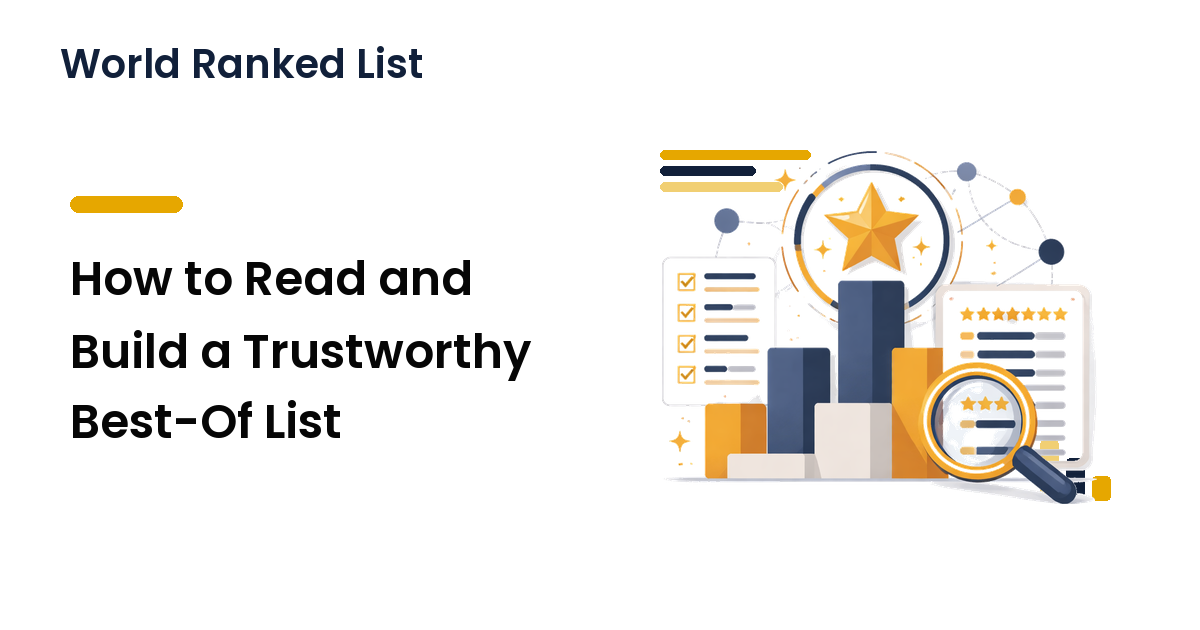
"Best of" lists are how most people shop now. Before buying a laptop, a mattress, a coffee grinder, or a project-management tool, we look for someone who has already done the comparing and ranked the field. A good roundup saves hours and points you to a genuinely strong choice for your situation. A weak one just reshuffles whatever was easiest to test — or whatever paid the most — and dresses it up as a verdict.
The short version: a trustworthy best-of list tells you what it measured, who each pick is for, and why one option beat another. The most useful entry is rarely the one crowned "#1" — it's the one whose strengths match your situation. This guide shows you how to read these lists critically, how to pick from them well, and, if you publish them, how to build one people can trust.
What a best-of list is really promising
A best-of list makes an implicit promise: we evaluated the field so you don't have to, and here's how it sorts out. That promise is only worth something if the evaluation was real and the reasoning is visible. The mechanics underneath are the same as any ranking — choose options, score them against criteria, and order the results — which we cover in depth in how rankings are made. A roundup is just that machine pointed at things you might buy.
So the question to ask of any list isn't "is this the best?" It's "best at what, for whom, and how do they know?" Once you ask it that way, the trustworthy lists and the filler separate quickly.
The marks of a list you can trust
A few traits reliably distinguish a genuinely useful roundup from a thin one.
Stated criteria
A trustworthy list tells you what it judged on — price, durability, ease of use, support, whatever matters for the category — before it shows you the winners. If a roundup never says what it measured, the order is decoration. Criteria are the difference between "we tested these on battery life and weight" and "here are ten laptops we found."
Contextual picks, not one universal winner
The strongest lists don't crown a single champion for everyone. They name a best for beginners, a best on a budget, a best for heavy use — because the right pick genuinely depends on who's choosing. A list with exactly one winner and no context is either covering a very narrow category or hiding the trade-offs. Real categories have trade-offs, and an honest list shows them.
A reason for every position
Each pick should come with the reason it earned its spot, tied to a criterion. "Best budget pick — lowest price of the group while still passing our durability test" is a reason. "Editor's choice" on its own is not. When every entry has a stated reason, you can judge whether the order is earned or arbitrary.
Visible scoring and testing
How did they decide? Hands-on testing, lab measurement, long-term use, or an aggregate of user reviews each tells you something different about reliability. A roundup that explains its method — and ideally how many units or users it's based on — is far more trustworthy than one that asserts results with no visible work behind them.
Honest disclosure
Many roundups earn affiliate commissions, and that's not automatically a problem — but it has to be disclosed plainly, and it shouldn't be the reason for the order. Be wary when the "winners" all happen to be the highest-commission products, or when disclosure is buried. A commission is not a criterion.
How to read any best-of list in two minutes
You don't need to distrust every list — you need a quick filter. Run these checks:
- Find the criteria. What did they measure? No criteria, lower your trust.
- Match a pick to yourself. Skip the "#1" and look for the entry labelled for your use, budget, or skill level.
- Read the reason for that pick. Does it tie to a criterion you care about, or is it just praise?
- Check how they tested. Hands-on, lab, or aggregated reviews — and on what sample?
- Look for disclosure. Sponsored or affiliate links stated up front? Do the winners track who pays rather than who scores?
If a list passes, trust its shortlist and verify your top one or two choices. If it dodges these, treat it as a starting point — a list of candidates to research, not an answer.
How to choose the right pick for you
The headline "best overall" is built for an average person who doesn't exist. The smarter move is to choose by fit:
- Name your must-haves first. Decide which one or two criteria actually matter to you — price, size, a specific feature — before you read the picks. This stops a persuasive write-up from selling you on qualities you don't need.
- Find the entry that optimizes for those. A good list makes this easy with "best for…" labels; on a list without them, read each pick's reason and match it yourself.
- Read the trade-offs, not just the praise. Every pick gives something up. The "premium" choice costs more; the "budget" choice cuts something. Knowing what each sacrifices tells you whether the sacrifice matters for you.
- Cross-check one independent source. If two unrelated, transparent lists agree on a pick for your use case, that's a stronger signal than any single roundup.
If you build best-of lists: do it honestly
The same traits that make a list trustworthy to read make one worth building. If you publish roundups:
- Define and publish your criteria before you rank. Decide what matters for the category, and say so. Choosing criteria after you've picked a winner is how reverse-engineered, biased lists happen.
- Weight criteria to match the reader. A "best for beginners" list should reward ease of use, not advanced features. The weighting is your editorial opinion — make it fit the audience and state it.
- Give contextual picks. Offer a best-for-budget, a best-for-power-users, and so on, rather than forcing one winner onto everyone.
- Show your work. Explain how you tested or what your scoring is based on. When live testing isn't possible, say the conclusions are based on commonly used criteria and publicly reported signals — and never invent numbers to look authoritative.
- Disclose plainly and keep it current. State any affiliate relationship up front, and revisit the list as products change. A stale roundup confidently recommending a discontinued product erodes trust fast.
FAQ
Is the "#1" pick always the best choice for me?
No. The top spot usually reflects an overall average or the author's weighting, not your specific needs. The best entry for you is the one whose strengths match your situation — often a "best for budget" or "best for beginners" pick rather than the headline winner.
How can I tell if a best-of list is just affiliate marketing?
Check whether it states real criteria and a reason for each pick, and whether disclosure is plain. Affiliate links aren't disqualifying on their own, but if the winners line up with the highest commissions and there's no visible testing or method, treat the order with caution.
Why do best-of lists disagree so often?
Usually because they measured different things or weighted the same criteria differently. A list that prioritizes price will rank a category very differently from one that prioritizes performance — and both can be honest. The disagreement is a reason to read the criteria, not to give up.
How many lists should I check before buying?
Two or three transparent, independent ones is usually enough. If they converge on a pick for your specific use case, that's a strong signal. Beyond that, you hit diminishing returns and should verify your finalist directly.
What makes a buying guide trustworthy to build?
Stated criteria chosen before ranking, weighting that matches the audience, contextual "best for" picks, visible testing or sourcing, and honest disclosure. In short: show what you measured, who each pick is for, and why — and keep it current.
Before you trust the next list
A best-of list is a tool, not a verdict. The next time one tells you what to buy, spend two minutes finding its criteria, then pick the entry labelled for your situation rather than the one labelled "#1." Read the reasons and the trade-offs, not just the order. For more on how the rankings behind these lists are actually built and scored, see how rankings are made — and explore the rest of World Ranked List for guides that show their work.